There's a new way to make a 2D game: you describe, an AI coding agent builds. But mid-build, every agent hits the same wall — “now I need a character sprite sheet” — and stalls on placeholder art. Spriterrific removes that wall: an HTTP API and an installable agent skill let the agent generate real, consistent, animated characters without leaving the session.
This isn't hypothetical. Two projects documented on this site were art-directed by agents:
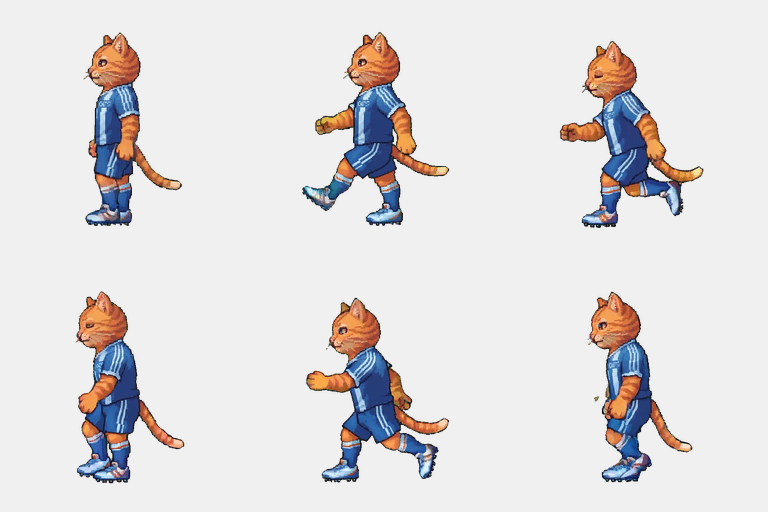
- A Three.js 3v3 football game whose cat, dog and rabbit players were all enqueued, polled, downloaded and integrated by an agent in a cold-start test project — nothing installed except the skill file and an API key.
- A Unity 6 platformer facelift where an agent generated the player, enemy and animated props, then wrote the import pipeline.
Setup: two artifacts, no SDK
- API key — created on the Quickstart page at app.spriterrific.com. Goes in your project's
.envasSPRITERRIFIC_API_KEY. - The skill — one markdown file that teaches the agent the endpoints, parameters, costs, and judgment (when to use a variant vs a new character, how to steer a bad walk, when not to spend credits). The Quickstart offers a zip that unpacks into both
.claude/skills/and.agents/skills/.
That's the whole integration. The API is plain HTTP.
What the agent's loop looks like
The skill teaches a disciplined loop — this is condensed from the actual skill file:
BASE=https://courteous-mouse-611.convex.site
AUTH="Authorization: Bearer $SPRITERRIFIC_API_KEY"

# 1. Pre-flight: check balance, report expected cost to the user.
curl -s -H "$AUTH" "$BASE/api/v1/me"

# 2. Enqueue a character with its first animations.
curl -s -X POST -H "$AUTH" -H "Content-Type: application/json" \
  -d '{
    "type": "character",
    "characterName": "cat-footballer",
    "sourcePrompt": "a cat footballer wearing a sports jersey, empty hands, no ball, no props",
    "gameView": "platformer",
    "direction": "w",
    "actions": ["walk", "idle"]
  }' "$BASE/api/v1/jobs"

# 3. Share the live run page, keep working, poll every ~15s.
#    https://app.spriterrific.com/jobs/$JOB_ID
curl -s -H "$AUTH" "$BASE/api/v1/jobs/$JOB_ID"

# 4. Download artifacts into the project.
curl -s -o spriterrific-runs/cat/walk/spritesheet.png "<artifact url>"
Details the skill gets right so your agent doesn't have to learn them the expensive way:
- Costs are stated up front. 30 credits per image generation, 100 per animation; the skill has the agent compute and report the debit before enqueueing. Validation failures (400s) cost nothing.
- Job responses are enveloped (
{ "job": { "status": ... } }); the skill points agents at the right fields so pollers don't loop forever. - Artifacts land in the repo under
spriterrific-runs/<name>-<jobid>/— sheets, previews, manifests, plus the job record for reproducibility — because a game can'timporta remote URL. - Anti-patterns are named. Don't regenerate a whole character to fix one animation (run a 100-credit action job); don't re-roll video to fix frame timing (use the free frame picker); don't rebuild a character from a new prompt to change its outfit (use a variant — text can't pin identity).
Agents make surprisingly good art directors
The football project is a nice case study in agent judgment encoded by the skill:
- It appended “empty hands, no ball, no props” to every player prompt — because "footballer" invites a ball into every anchor.
- When the game needed moves the standard set doesn't name, it created custom actions:
kickmapped to the attack motion preset, andsliding-tacklewith the context note “low aggressive slide along the ground, leading leg extended”. - It integrated the results into a UV-animated billboard system with per-character metadata — the full integration is documented in the Three.js guide.
Meanwhile the Unity agent handled the other end of the pipeline: import settings, feet pivots, Animator clips, and a regression check that sprite feet touch the frame bottom — written up in the Unity guide.
Humans stay in the loop where it counts
Every job an agent enqueues has a live run page on app.spriterrific.com with step-by-step progress, artifact previews, and an interactive frame picker. The agent does the plumbing; you glance at the previews and say "the walk's too bouncy" — and the agent steers a re-roll or re-picks frames (free) accordingly.
New accounts include 500 free credits — enough for your agent's first character with two animations. Mint a key on the Quickstart page and paste one line into your next session: "install the spriterrific-api skill and generate our player character."